
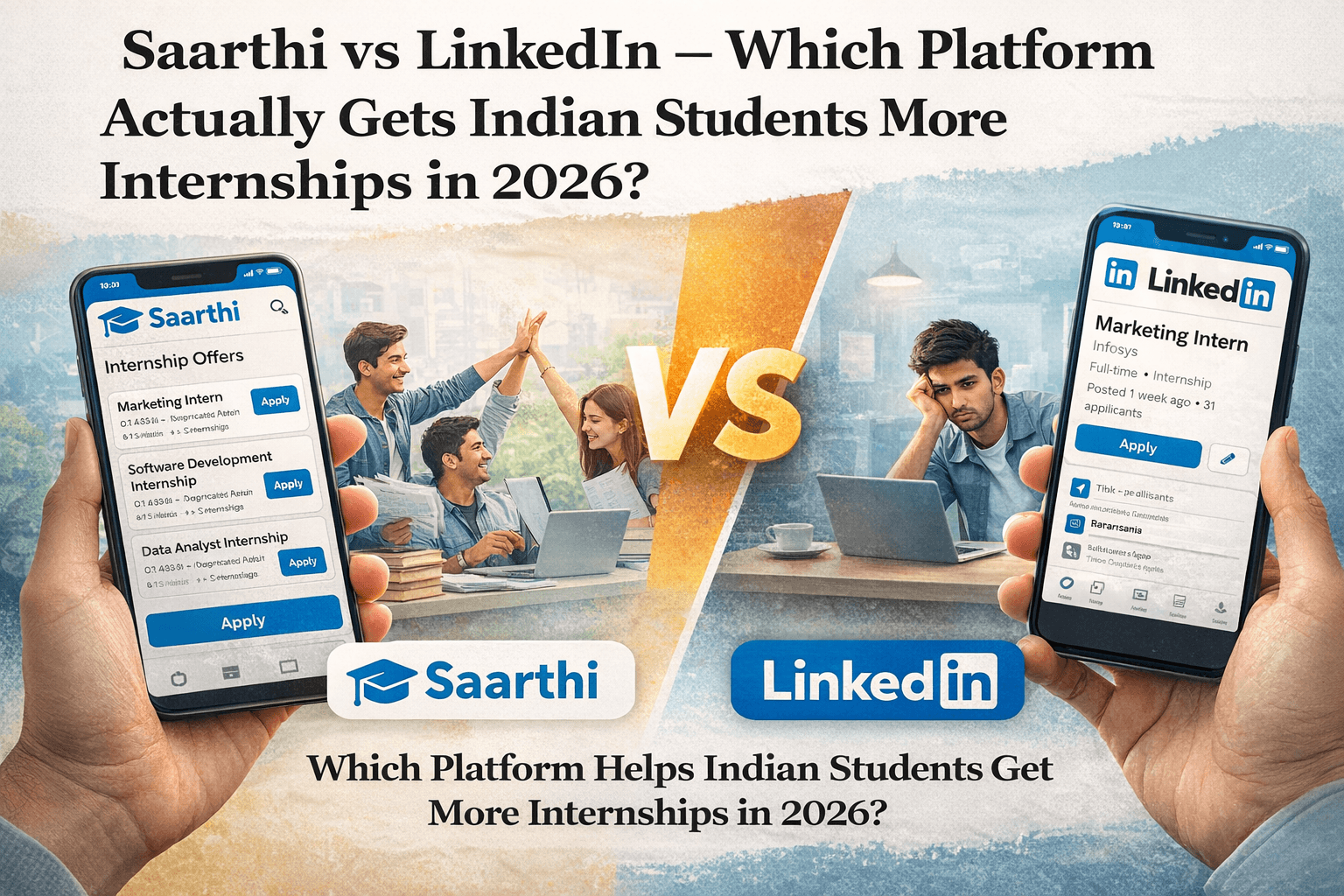
Saarthi vs LinkedIn – Which Platform Actually Gets Indian Students More Internships in 2026?
 Saarthi Team|Apr 2026|12 min read
By Saarthi Team | April 2026 | 12 min read
Every student in India right now is doing the same thing. They are building a LinkedIn profile, connecting with recruiters, posting about their projects, and applying to internship listings — and then waiting. And waiting. And waiting some more. Meanwhile, their college friends who quietly downloaded Saarthi are getting interview calls for internships within days. Not because they are more talented. Not because they have better resumes. Because they are using the right platform for the right purpose at the right stage of their career. This article is not here to bash LinkedIn. LinkedIn is genuinely powerful and you absolutely need a profile there. But this article is going to be completely honest about something that most career advice does not say clearly — LinkedIn was not built for Indian college students trying to get their first internship, and using it as your primary internship hunting tool is one of the most common and costly mistakes Indian students make in 2026. Let us break down exactly why, and what you should be doing instead.
Why Every Student Is on LinkedIn — and Why That Is Part of the Problem
LinkedIn launched in 2003 and has grown into the world's largest professional networking platform with over 1 billion members globally. In India alone, LinkedIn has over 110 million users. That sounds like an enormous opportunity. In reality, for a college student with no work experience, that number is the problem — not the solution.
When you post on LinkedIn as a student with zero experience, your post reaches a tiny fraction of even your own connections because LinkedIn's algorithm prioritises content from people with established professional credibility. When you apply for an internship on LinkedIn, your application joins hundreds or thousands of others from students across India, professionals looking to re-enter the workforce, and people from other countries targeting remote roles. The recruiter sees a flood of applications and typically sorts by mutual connections, endorsements, or profile completeness metrics that take months to build.
LinkedIn rewards people who have already built a professional presence. For someone just starting out, building that presence while simultaneously trying to land your first internship is genuinely difficult and slow. Most students spend three to four months on LinkedIn before getting a single meaningful response.
What LinkedIn Is Actually Good At — And What It Is Not
Before comparing the two platforms fairly, it is important to be honest about what LinkedIn genuinely does well, because dismissing it entirely would be misleading.
LinkedIn is excellent for researching companies before interviews. It is powerful for understanding who works at a company you want to join, what their career paths looked like, and what skills the company values. LinkedIn is valuable for building your professional identity over time — a well-maintained LinkedIn profile becomes an asset that compounds in value the longer you invest in it. It is also the best platform currently available for cold outreach to professionals, alumni, and senior people in your target industry.
What LinkedIn is not good at — and this is the honest part — is getting a college student with no experience their first internship quickly. The platform was built for professionals, not for students. The internship listings on LinkedIn are open to the entire country and often the entire world. The algorithm does not protect or prioritise freshers. And without an existing network of professional connections, your profile has almost no organic reach.
According to a detailed study covered by Forbes on college hiring trends, students who rely solely on large professional networking platforms for their first internship search take an average of five to seven months longer to get placed than those using niche, targeted platforms built for their specific stage of career.
What is Saarthi and Why Was It Built
Saarthi is a career platform built in 2024 specifically to solve one problem — getting Indian college students and freshers into their first internship or job without the stress, confusion, and months of silence that define most first-time job searches in India.
Every single decision made while building Saarthi started with one question: does this actually help a student with zero experience get hired faster? That question produced a platform that looks and feels completely different from anything else in the Indian market.
All internship and job listings on Saarthi are exclusively for freshers and students. Every listing is manually verified before it goes live. The AI resume builder creates an ATS-formatted resume automatically. The Job Fit Score shows you your exact match percentage with a listing before you apply, so you stop wasting time on applications that were never going to convert. And the off-campus placement drives section brings together drives from companies that most students would never find on their own.
Saarthi currently has over 10,000 verified listings and has helped more than 6,000 Indian students land their first internship or job. You can explore the complete breakdown of every feature on the Saarthi features page.
Saarthi vs LinkedIn — The Complete, Honest Comparison
Who the platform was built for LinkedIn was built for working professionals at every career stage — from interns to CEOs, from freshers to thirty-year veterans. Everyone is on the same platform competing for the same attention from recruiters. Saarthi was built exclusively for Indian college students and freshers. Every feature, every listing, and every design decision was made with this specific user in mind. There is no competing with experienced professionals because they are simply not on the platform.
Internship listings and quality LinkedIn has a large volume of internship listings but they come with serious problems for students. Many are open to the entire country and beyond, creating enormous competition. Many are not updated and list opportunities that have already been filled. There is no verification system for whether a company is legitimately hiring or whether the listing is a ghost post. And critically, listings that say "internship" often have hidden requirements like prior experience, completion of a bootcamp, or a portfolio that most college students do not have yet. Saarthi's listings are exclusively for students and freshers, manually verified as active before going live, and genuinely require zero prior experience. Every listing you see on Saarthi is a real, open opportunity that was posted for someone exactly like you.
Resume help LinkedIn has no resume builder. It allows you to export your LinkedIn profile as a PDF, which is not ATS-formatted and should generally not be submitted as a formal job application resume. LinkedIn does offer some AI-powered profile suggestions in its premium tiers but this does not help with your actual resume document. Saarthi has an AI resume builder that creates a complete, ATS-formatted resume in one click based on your inputs. This is critical because, as we explain in our detailed guide on how to use AI tools to get a job faster in 2026, over 70 percent of resumes submitted by freshers are automatically rejected by ATS systems before any human reads them. If your resume is not ATS-formatted you are invisible, no matter how strong your actual profile is.
Understanding your chances before applying LinkedIn does not tell you how strong a match you are for a listing before you apply. You see a job, you apply, and you hope for the best. There is no signal about whether your background is relevant, whether you are overqualified or underqualified, or whether you have any realistic chance of moving forward. Saarthi's Job Fit Score shows you a percentage match between your profile and every listing before you apply. This changes how you approach internship hunting entirely. Instead of spraying a hundred applications in every direction and hoping something sticks, you identify listings where you are a 70 or 80 percent match and concentrate your energy there. The result is fewer applications with dramatically higher conversion rates.
Competition you actually face On LinkedIn, when you apply for an internship at a reasonably well-known company, you are competing with every other student in India who saw the same listing, plus students from other countries targeting remote roles, plus professionals looking to make a career switch at a junior level who are willing to accept intern-level stipends. It is genuinely one of the most crowded competitive environments a college student can enter. On Saarthi, you are only competing with other freshers and students. The experienced professionals, career switchers, and international applicants simply are not there. Your actual competition is limited to people at your same starting point, which changes your odds of success dramatically.
Off-campus placement drives LinkedIn has no dedicated section for off-campus placement drives. Companies occasionally post about drives on LinkedIn but this information is scattered across company pages, recruiter profiles, and group posts. Most students miss the majority of available drives simply because they never see the announcement. Saarthi has a dedicated off-campus section that aggregates drives from companies across India into one place. These are drives that most students would never find on their own — companies that do not rely on traditional job boards, startups with active hiring needs, and mid-sized companies in tier two and tier three cities that are actively looking for fresh talent. If your college placement cell is not very active, this section alone is worth downloading Saarthi for. For students specifically targeting roles at large companies, our guide on how to get a job in an MNC as a fresher in 2026 walks through exactly how to use off-campus drives strategically.
Cold outreach and networking This is where LinkedIn genuinely wins over Saarthi and it is important to acknowledge that clearly. LinkedIn's core strength is that it allows you to find and directly message professionals, alumni, hiring managers, and founders. A well-crafted cold message on LinkedIn to the right person can open doors that no job application ever could. Saarthi is not a networking platform. It is a job and internship discovery and application platform. It does not have the cold outreach functionality that LinkedIn has. If your strategy involves reaching out directly to people in your target company or industry — which is a very effective strategy — LinkedIn is the right tool for that specific activity.
Profile as a long-term professional asset A LinkedIn profile that you build consistently over months and years becomes a professional asset that compounds in value. Recruiters who find you on LinkedIn see your entire professional story — your education, your projects, your endorsements, your activity, your connections. Over time this creates trust and credibility that no application form can replicate. Saarthi is optimised for right now — for getting you your first internship as quickly as possible with the profile you currently have. It is not designed to be a long-term professional identity platform in the way LinkedIn is.
What Indian Students Get Wrong About LinkedIn
The most common mistake Indian college students make with LinkedIn is treating it like a job board when it is actually a networking platform. Applying to internships through LinkedIn's job listings is one of the least effective things you can do on the platform as a student. It puts you in the largest possible pool of competition with the least possible differentiation.
What LinkedIn is actually powerful for, used correctly, is building connections with alumni from your college who are now working at companies you want to intern at, reaching out directly to founders of startups with a specific and genuine reason for wanting to work with them, engaging meaningfully with content from people in your target industry so they recognise your name before you reach out, and building a professional profile that recruiters who find you through other channels will check before making a decision.
The right mental model is this: use LinkedIn to build relationships and be discoverable. Use Saarthi to actually find and apply for internships. These are fundamentally different activities and the best students do both simultaneously.
Research from Glassdoor's hiring trends data consistently shows that employee referrals and direct outreach convert at dramatically higher rates than cold applications through job boards — which is exactly why building LinkedIn relationships matters, but also why spamming LinkedIn job listings rarely works for students with no existing network.
The Real Numbers — What Students Actually Experience
The gap in results between students who use Saarthi as their primary internship platform versus students who rely primarily on LinkedIn job listings is significant and consistent.
Students using LinkedIn as their primary internship application tool typically report sending 80 to 150 applications before receiving their first positive response, a process that takes three to six months. The primary reasons are ATS rejections due to unformatted resumes, high competition from experienced applicants in the same listings, and lack of any signal about whether their profile is a strong match before applying.
Students who use Saarthi as their primary platform consistently report receiving interview calls within one to three weeks of starting, applying to significantly fewer listings because the Job Fit Score helps them target effectively, and discovering opportunities through the off-campus section that they would never have found through LinkedIn or any other platform.
Rahul, a final year B.Tech student from Pune, spent four months applying through LinkedIn and Naukri with almost zero results. Within nine days of switching to Saarthi as his primary platform, he received an interview call. His experience is consistent with what thousands of Saarthi users report, which you can read about on the Saarthi testimonials page.
How to Use Both Platforms Together — The Complete 2026 Strategy
The most effective approach is not choosing one platform and ignoring the other. It is understanding exactly what each platform does best and using them simultaneously for different purposes.
Use Saarthi every day for internship discovery and application. Check new listings each morning. Apply only to listings where your Job Fit Score is above 60 percent. Use the AI-generated ATS resume for every application. Check the off-campus drives section daily because drives close quickly and missing the window means missing the opportunity entirely.
Use LinkedIn for networking and visibility building. Connect with alumni from your college who are working in your target industry. Send personalised connection requests with a specific and genuine message — not a generic "I would like to connect." Engage with posts from people at companies you want to intern at. Build your profile consistently — add every project, course, certification, and skill that is relevant to your target internship.
Use the same ATS-optimised resume that Saarthi's AI generates across all platforms. Do not create a separate visual resume for LinkedIn applications. The Saarthi-generated resume is formatted to pass automated filters, which matters on every platform you apply through.
Check Saarthi's off-campus section specifically for opportunities in companies that do not heavily recruit through LinkedIn. Many growing startups, established companies in tier two cities, and businesses in industries like manufacturing, retail, and logistics actively hire freshers through drives but rarely post on LinkedIn.
Track everything. Know which listings you applied to, when, through which platform, and what the result was. After four weeks you will have clear data on which platform and which type of listing is generating the most callbacks for your specific profile, and you can double down on what is working.
Who Should Use Which Platform as Their Primary Tool
Final year student with zero experience looking for your first internship: use Saarthi as your primary application platform and LinkedIn for networking simultaneously.
Student in second or third year looking for a summer internship: use Saarthi as your primary discovery and application tool. Your limited time makes the Job Fit Score especially valuable — you cannot afford to spend weeks applying to opportunities that were never going to convert.
Student whose college does not have active placement drives: use Saarthi's off-campus section as your primary source of opportunities. It was built specifically for this situation.
Student who has already completed one internship and is looking for a second: use both platforms equally. Your first internship experience makes your LinkedIn profile meaningfully stronger and your competition on Naukri and other platforms more balanced.
Student targeting a specific company or industry: use LinkedIn to research, connect, and reach out directly to people at your target company. Use Saarthi to apply through the formal process simultaneously. Both tracks matter.
The Bottom Line
LinkedIn and Saarthi are not competitors doing the same thing. They are different tools designed for different purposes, and understanding that distinction is what separates students who get internships quickly from those who spend months in frustration.
LinkedIn is a long-term professional relationship and visibility platform. It rewards people who have already built credibility and connections. For a college student just starting out, it is an investment that pays off over months and years — not immediately.
Saarthi is a right-now internship and job discovery platform built specifically for Indian students and freshers. It removes the structural barriers that make platforms like LinkedIn and Naukri so difficult for freshers to succeed on — ATS formatting, competition from experienced candidates, fake listings, and lack of match signals.
If you want an internship this month, start with Saarthi. If you want to be discoverable by recruiters for years to come, build your LinkedIn simultaneously. Do both. But do not make the mistake of treating LinkedIn job listings as your primary internship hunting strategy and then wondering why it is not working.
Frequently Asked Questions
Is Saarthi better than LinkedIn for finding internships as a student in India? For the specific purpose of finding and applying to internships quickly as a student with zero experience, Saarthi is significantly more effective than LinkedIn. Saarthi lists only fresher-specific opportunities, shows your match percentage before you apply, and removes the competition from experienced professionals that makes LinkedIn applications so difficult for students. LinkedIn is better for networking, building long-term professional visibility, and direct outreach to people at companies you want to work at. The best strategy uses both simultaneously for different purposes.
Can I use Saarthi and LinkedIn at the same time? Yes, and this is the recommended approach. Use Saarthi every day for internship discovery and applications. Use LinkedIn for building professional connections, researching companies, and making your profile discoverable over time. They serve fundamentally different functions and work significantly better together than either does alone.
Why is it so hard to get internships through LinkedIn as a student? The core problem is competition. LinkedIn is a platform for everyone — students, freshers, experienced professionals, career switchers, and international job seekers all apply to the same listings. As a student with zero experience your application enters the largest possible competitive pool with the least possible differentiation. Additionally, most students submit resumes through LinkedIn that are not ATS-formatted, meaning they are automatically filtered out before any human reads them. Platforms built specifically for freshers like Saarthi solve this by limiting the pool to people at your same career stage.
Does LinkedIn actually help students get internships in India? LinkedIn helps students get internships most effectively through networking and direct outreach — not through applying to job listings. If you connect with alumni at your target company and one of them refers your application internally, your chances improve dramatically compared to a cold application. But relying on LinkedIn job listings as a student without an existing professional network is one of the slowest ways to find an internship in India in 2026.
Is Saarthi free for students? Yes, Saarthi is completely free to download and use for students on both Android and iOS. Every feature — the AI resume builder, Job Fit Score, verified listings, and off-campus placement drives — is accessible without any payment.
What types of internships are available on Saarthi? Saarthi has internships across a wide range of fields including technology, marketing, finance, human resources, content writing, data analysis, design, and operations. All listings are exclusively for students and freshers with zero to minimal prior experience required. Every listing is manually verified as active before going live.
How does the Job Fit Score work on Saarthi? The Job Fit Score is an AI-powered feature that calculates how closely your profile matches the requirements of a specific listing before you apply. It analyses your skills, educational background, location, and experience level against what the company has specified. A higher score means you are a stronger match and have a better chance of getting a callback. This helps you prioritise your applications strategically rather than applying randomly to every listing you see.
Should students build a LinkedIn profile even if they use Saarthi? Yes, absolutely. LinkedIn and Saarthi serve different purposes and a profile on both is important. Your LinkedIn profile is a long-term professional asset that becomes more valuable over time. Recruiters who find your resume through Saarthi or any other platform will often check your LinkedIn profile before deciding whether to call you. Building it consistently from your college years means it is already established and credible by the time you are in the final stages of your first job search.
What is the best internship app for college students in India in 2026? Saarthi is the most purpose-built internship and fresher job app for Indian college students in 2026. It combines verified fresher-only listings, an AI resume builder, a Job Fit Score, and a dedicated off-campus placement drives section — all for free. For students specifically, no other single platform currently combines all of these features in one place.
How is Saarthi different from LinkedIn for internship hunting? Saarthi is an internship discovery and application platform built exclusively for freshers and students. LinkedIn is a professional networking platform built for everyone at every career stage. On Saarthi you only compete with other freshers, every listing is verified and fresher-specific, and the AI tools are designed to maximise your chances as a zero-experience applicant. On LinkedIn you compete with the entire professional world, listings are unverified, and the tools are optimised for people who already have established professional profiles.